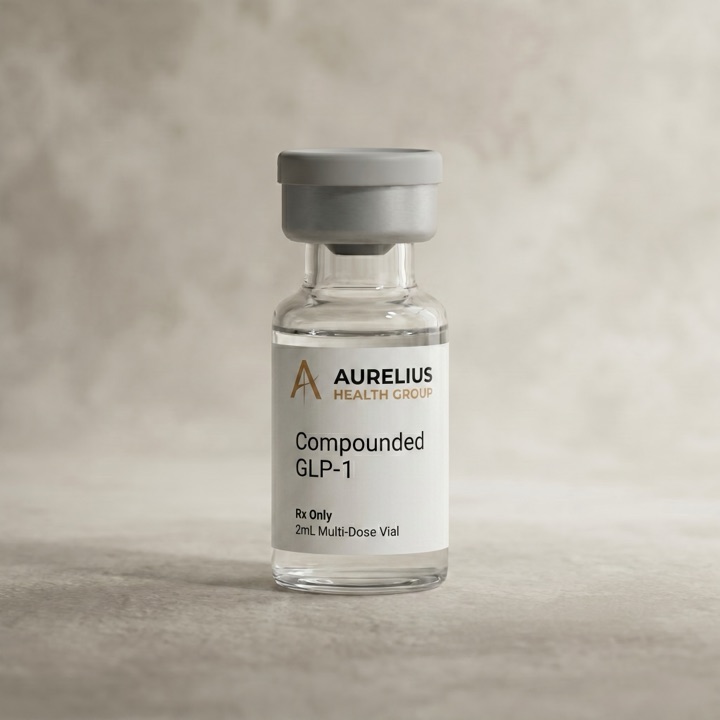
How semaglutide works at any dose
Semaglutide is a GLP-1 receptor agonist with 94% sequence homology to the natural hormone GLP-1. It binds receptors across multiple organ systems simultaneously: in the hypothalamus and brainstem, suppressing appetite and food cravings; in the pancreas, stimulating glucose-dependent insulin release; in visceral adipose tissue, reducing inflammatory adipokine secretion and lipogenesis; and in the gastrointestinal tract, slowing gastric emptying. Its fatty acid chain binds albumin in the bloodstream, extending the half-life from two minutes to approximately one week, which makes once-weekly dosing possible.
Critically, these different effects do not all share the same dose-response relationship. That distinction is the entire scientific basis for the microdosing argument.
The dose-response curve: where the data actually sits
The largest gains in efficacy occur between 0.25 mg and 1.0 mg. Moving from 1.0 mg to 2.4 mg adds roughly 5 to 6 percentage points of additional weight loss. Meanwhile, side effects increase at each step, but far more gradually than efficacy. The STEP 2 trial demonstrated that doubling the dose from 1.0 mg to 2.4 mg increased gastrointestinal adverse events from 57.5% to 63.5%, while discontinuation rates moved from just 3.5% to 4.2%.
The clinical implication is that a substantial portion of semaglutide's metabolic benefits are already present at low-to-moderate doses. The additional weight loss from escalating to maximum dose comes at a real tolerability cost, and the risk-benefit calculation looks very different depending on the reason for taking the medication.
What the full dose achieves: the STEP trial data
The STEP 1 trial enrolled 1,961 adults with a BMI of 30 or above, randomised 2:1 to semaglutide 2.4 mg or placebo for 68 weeks. Mean weight loss was 14.9% in the semaglutide group versus 2.4% in placebo. The two-year STEP 5 trial confirmed durability at 15.2%, and the 2025 STEP UP trial at 7.2 mg weekly demonstrated 20.7% weight loss, confirming the dose-response relationship continues above the approved ceiling. The SELECT cardiovascular outcomes trial, involving 17,604 adults with pre-existing cardiovascular disease and obesity, showed a 20% reduction in major adverse cardiovascular events at 2.4 mg over a mean follow-up of 39.8 months. That cardiovascular benefit is the most powerful argument for maximising dose in high-risk patients.
What full dose does to body composition
The STEP 1 DEXA substudy found that approximately 45% of total weight lost at 2.4 mg came from lean tissue, substantially above the classical prediction of roughly 25% lean loss during caloric restriction. A 2025 retrospective cohort study followed 220 adults on semaglutide for 24 months and found dose was an independent predictor of muscle mass loss. The mechanism is straightforward: higher doses produce more aggressive appetite suppression, creating a larger caloric deficit, which drives lean mass loss whenever protein intake and resistance training are inadequate.
A 2025 case series demonstrated that patients who trained with resistance exercise 3 to 5 days per week and consumed 1.6 to 2.3 g protein per kg of fat-free mass lost 90% of their weight as fat. This is not a reason to avoid full dose, but it means the lifestyle protocol must be treated as inseparable from the pharmacology, not an optional add-on.
Microdosing: what it means clinically and what the evidence shows
The American Diabetes Association formally acknowledged microdosing in a February 2025 paper in Diabetes Care as a legitimate clinical strategy for patients experiencing intolerable gastrointestinal side effects, those transitioning between GLP-1 agents, patients paying out of pocket who need to extend pen supplies, and those for whom standard doses are not appropriate. There are no dedicated randomised controlled trials below 0.25 mg weekly, but the evidence for the 0.5 to 1.0 mg range is meaningful, and a growing real-world dataset is emerging. One dedicated clinical trial (NCT07092605, registered July 2025) is now specifically studying microdosed GLP-1 receptor agonists for health outcomes.
Full dose vs. low dose: the direct comparison
The adherence problem: the number most people ignore
In STEP 1 trial conditions with free medication and intensive support, 91% of participants were still on treatment at 68 weeks. In real-world commercial insurance data, the picture is starkly different: only 36% remained on medication at six months, and just 14.3% at twelve months, with cost and side effects as the primary reasons for stopping. The STEP 4 withdrawal trial showed what happens when you stop: participants who discontinued after 20 weeks of semaglutide regained a mean of 6.9% of body weight within the following 48 weeks. A drug taken consistently for three years at 75% efficacy typically outperforms a drug taken at 100% efficacy for eight months followed by rebound.
What specifically improves at lower doses: the organ-level effects
Visceral fat responds to semaglutide at doses below the obesity maintenance threshold. GLP-1 receptors are expressed directly on visceral adipocytes, and the drug modulates adipokine secretion and lipogenesis in visceral depots via AMPK signalling. The anti-inflammatory effects, including suppression of IL-6 and TNF-alpha and inhibition of the NLRP3 inflammasome, appear in preclinical models at low receptor occupancy. Insulin sensitivity improves through both direct pancreatic effects and indirect effects via reduced hepatic steatosis and lower portal free fatty acid flux from shrinking visceral fat.
For men specifically, visceral fat reduction has a hormonal consequence that is rarely discussed. Visceral adipocytes are a primary site of aromatase enzyme activity, which converts testosterone to oestradiol. Elevated aromatase in men with visceral obesity suppresses luteinising hormone via hypothalamic-pituitary negative feedback, reducing testicular testosterone synthesis. Studies have documented improvements in testosterone as a secondary consequence of GLP-1-driven visceral fat reduction at weight loss levels of 7 to 10%, achievable at lower doses. For men whose functional hypogonadism is adiposity-driven, a protocol combining GLP-1 receptor agonism with targeted hormonal support may support the underlying metabolic drivers — rather than simply supplementing suppressed hormones.
A drug taken consistently at lower dose for three years typically outperforms a drug taken at full dose for eight months, followed by discontinuation and rebound.
Who should consider each approach
High-risk, high-BMI patients
- BMI above 35 with comorbidities
- Established cardiovascular disease
- Type 2 diabetes or NASH
- Obstructive sleep apnoea
- Primary goal is maximum weight reduction
- Can tolerate dose escalation
Metabolic optimisation patients
- BMI 27–32, seeking metabolic health
- Previously discontinued due to side effects
- Physically active, protein intake adequate
- Lean mass preservation a priority
- Visceral fat and hormonal disruption
- Long-term adherence over peak efficacy
Long-term weight trajectory: the full picture
The chart below illustrates what the data show when you model real-world trajectories rather than idealized trial conditions. The full-dose line peaks at 15% weight loss around month 12, then climbs toward baseline after discontinuation. The lower-dose trajectory with embedded lifestyle change shows a shallower slope but far more durable results at 24 to 36 months.
The bottom line
Full-dose semaglutide at 2.4 mg is among the most effective pharmacological tools ever developed for weight reduction in patients with significant obesity and weight-related comorbidities. The evidence for cardiovascular event reduction, glycaemic improvement, and visceral fat loss in this population is robust, replicated, and clinically transformative.
For a different patient — moderately overweight, metabolically disrupted, physically active, and seeking a two-year protocol rather than an eight-month sprint followed by rebound — the lower-dose calculation may produce a superior long-term clinical outcome. The dose should be set to serve the patient, not the other way around.
The right dose is the one a given patient will take consistently, with adequate lifestyle support, for long enough to produce durable metabolic change. For a large proportion of the people currently prescribed semaglutide who stop within eight months, that dose is not 2.4 mg.
Take the next step
Talk with a licensed provider
A 2 minute intake connects you with a licensed provider who reviews your health history and discusses whether treatment is appropriate for you.
$89 first month, then $199/month. Cancel anytime.
Start Your Journey Prescription only if clinically appropriate.