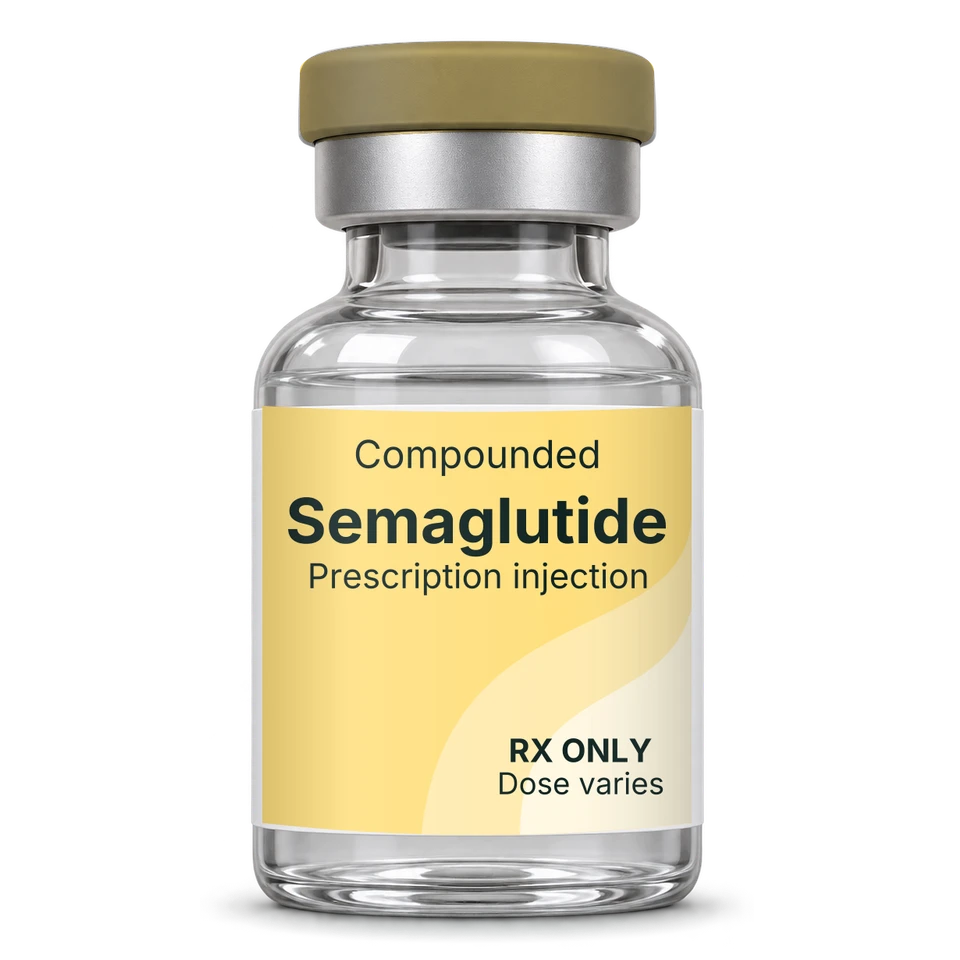


Rx onlySemaglutide (Compounded)
A prescription weekly injection that mimics the natural GLP-1 hormone to help regulate appetite, promote fullness after meals, and support sustainable weight management with ongoing clinician care.
- Form
- Injection under the skin
- Schedule
- Once a week
- Prescribed by
- Licensed US clinician
- Prepared by
- Licensed US pharmacy
Prescription required. A licensed clinician decides if it’s appropriate for you.
Trial results are for FDA-approved semaglutide 2.4 mg, not compounded semaglutide. Results vary.
Private online screener. A licensed clinician reviews every request.
What it is
Semaglutide is:
- A GLP-1 receptor agonist that mimics a gut hormone that signals fullness
- First used for type 2 diabetes, and FDA-approved as a brand-name medicine for chronic weight management
- Taken as one small injection under the skin, once a week
- Started at a low dose and increased over several weeks
Compounded medications are not FDA-approved and are not the same as the brand-name product. Results vary.
How it’s taken
A small injection under the skin of the stomach, thigh or upper arm, once a week on the same day, with or without food. Your care team shows you how. Use it exactly as your clinician prescribes.
Who prescribes it
A licensed US clinician reviews your screener and health history and decides whether semaglutide, and which form, is appropriate. If it is, a licensed US pharmacy prepares and ships your prescription, and your clinician checks in as your dose is adjusted.
Safety information
Boxed warning: possible risk of thyroid C-cell tumors. Do not use semaglutide if you or a family member have had medullary thyroid carcinoma (MTC), or if you have MEN 2. Do not use while pregnant. Common side effects include nausea, diarrhea, vomiting and constipation. Read the Important Safety Information.

The potential benefits of semaglutide.
Explore Semaglutide With a ClinicianSignificant weight loss
In STEP 1, a study of weekly semaglutide injections, adults plus a lifestyle program lost 14.9% of their body weight on average over 68 weeks, versus 2.4% on placebo.
Appetite and cravings
Semaglutide mimics GLP-1, a fullness hormone. It may quiet appetite and food cravings, which can make plateaus easier to get past.
Heart health
In SELECT, an injection study of people with heart disease, heart attack, stroke or cardiovascular death fell from 8.0% to 6.5% over about 40 months.
Metabolic health
In STEP 1, people on weekly injections saw greater improvements in cardiometabolic risk factors and physical functioning than those on placebo.
Results are from injection trials of FDA-approved semaglutide 2.4 mg (STEP 1, Wilding et al., NEJM 2021; SELECT, Lincoff et al., NEJM 2023). They are not results for compounded semaglutide, which is not FDA-approved. Individual results vary.
Who semaglutide may be for.
People who explore semaglutide with a clinician often recognize themselves in one of these. Open one to read more.
Semaglutide isn’t right for everyone. A licensed clinician reviews your health history and decides whether it’s appropriate. Trial results come from injection studies of FDA-approved semaglutide, not from compounded semaglutide. Prescription required. Individual results vary.

Weight Management, Medically Supervised.
Semaglutide is FDA-approved, as a brand-name medicine, for chronic weight management in adults with obesity. A licensed clinician decides whether compounded semaglutide fits you.
Weight Management, Medically Supervised.
Semaglutide is FDA-approved, as a brand-name medicine, for chronic weight management in adults with obesity. A licensed clinician decides whether compounded semaglutide fits you.
When Weight Affects Your Health.
For adults who are overweight and living with a weight-related condition, such as high blood pressure or high cholesterol, semaglutide may be part of a supervised plan.
When Progress Has Stalled.
If diet and exercise alone haven’t moved the scale, semaglutide may make appetite easier to manage, which can help you get past a plateau.
When Food Is Always on Your Mind.
Semaglutide acts on appetite signals in the brain and slows how quickly the stomach empties, which may quiet cravings and help you feel full sooner.
Looking After Your Heart.
In SELECT, an injection study, people with heart disease and excess weight who took semaglutide had fewer heart attacks, strokes and cardiovascular deaths than with placebo.
Where Semaglutide Started.
Semaglutide was first used for type 2 diabetes because it helps the pancreas release insulin when blood sugar is high. Your clinician reviews how it fits your current care.
Holding On to Your Progress.
In the STEP 4 injection study, people who stayed on semaglutide lost a further 7.9% over 48 weeks, while those who switched to placebo regained 6.9%. A long-term plan matters.
Not Doing This Alone.
Every prescription starts with a review by a licensed clinician, with check-ins as your dose is adjusted, so questions and side effects don’t go unanswered.

How does semaglutide work?
The short version, in three steps. Your clinician can walk you through the details.
01Mimics a gut hormone
Semaglutide mimics GLP-1, a hormone your gut releases after meals that signals fullness. It’s built to last about a week, so you take it once weekly.
02Quiets appetite
In the brain it may dampen appetite and food cravings. In the stomach it slows emptying, so you may feel full sooner and eat less.
03Dosed to you, weekly
Your clinician starts low and increases the dose over several weeks, based on how you respond and what you tolerate.
A simplified explanation of how GLP-1 medicines are understood to work. Effects vary from person to person. Compounded semaglutide is not FDA-approved.
One Dose a Week. Adjusted to You.
Semaglutide is one small injection under the skin, taken once a week. Your clinician starts you on a low dose and raises it gradually, only if it suits you.
Your clinician sets your starting dose and schedule and decides if and when to change them. Never change your dose on your own.


Small Steps. Progress Over Time.
Semaglutide starts low and increases gradually, with your clinician checking in along the way.
Week 1
Getting Started°
- Your first, lowest dose, taken once a week
- Learn the injection with your care team’s guidance
- Note your appetite, energy and any side effects
Week 4
Settling In°
- Your clinician reviews how you’re feeling
- Your dose may be stepped up if it suits you
- Stomach side effects are most common early on and after a dose change
Week 8
Checking Progress°
- Review changes in appetite, weight and wellbeing
- Adjust the plan with your clinician
- Keep building habits around food, movement and sleep
Ongoing
Personalized Support°
- Continue at the dose your clinician settles on
- Regular check-ins with your care team
- A long-term plan, including what happens if you stop
°Illustrative milestones, not guaranteed outcomes. Dose changes, timing and results vary from person to person, and some people don’t respond.
Questions, answered plainly.
Anything else, ask your clinician during your consult.

What is semaglutide?
Semaglutide is a GLP-1 medication. It was first used for type 2 diabetes and is FDA-approved, as a brand-name medicine, for chronic weight management. Aurelius Health Group clinicians prescribe compounded semaglutide as a weekly injection, prepared by a licensed US pharmacy. It is not FDA-approved, and it is not the same as a brand-name product.
Is compounded semaglutide FDA-approved?
No. Compounded medications are prepared by licensed pharmacies and are not FDA-approved, which means the FDA does not review them for safety, effectiveness or quality before they’re dispensed. A licensed clinician decides whether one is appropriate for you.
Who shouldn’t take semaglutide?
Anyone with a personal or family history of medullary thyroid carcinoma (MTC) or Multiple Endocrine Neoplasia syndrome type 2 (MEN 2), anyone who has had a serious allergic reaction to semaglutide, and anyone who is pregnant. Tell your clinician about any history of pancreatitis, gallbladder, kidney or eye problems, depression or suicidal thoughts, and every medication you take.
How is it taken?
The injection is a small shot under the skin of the stomach, thigh or upper arm, once a week on the same day, with or without food. Capsules are taken by mouth as your clinician prescribes. Your care team shows you how, and your clinician sets your dose.
What side effects are common?
Most are stomach-related: nausea, diarrhea, vomiting, constipation and stomach pain, plus headache and tiredness. They tend to show up early on or after a dose increase. Tell your care team about anything that concerns you, and get medical help right away for severe stomach pain that won’t go away.
How long until I notice anything?
It varies. Your dose starts low and rises gradually, so it often takes several weeks to reach the dose your clinician settles on, and some people don’t respond. Your clinician checks in along the way.
Can I take it with my other medicines?
Tell your clinician about everything you take. Semaglutide slows digestion, which may change how some oral medicines are absorbed, and it can raise the risk of low blood sugar with insulin or a sulfonylurea. Never stop a prescribed medication without talking to the doctor who prescribed it.
Does insurance cover it?
Compounded semaglutide usually isn’t covered by insurance, so most people pay out of pocket. It is only prescribed if a clinician decides it’s appropriate for you.
Important safety information.
Read this before starting semaglutide, and ask your clinician about anything that’s unclear.
Warning: risk of thyroid C-cell tumors
In studies in rodents, semaglutide caused thyroid C-cell tumors. It is not known whether it causes these tumors, including medullary thyroid carcinoma (MTC), in people. Do not use semaglutide if you or any of your family have ever had MTC, or if you have Multiple Endocrine Neoplasia syndrome type 2 (MEN 2). Tell your clinician right away if you get a lump or swelling in your neck, trouble swallowing, hoarseness or shortness of breath.
Do not use if you
- Have a personal or family history of MTC, or have MEN 2
- Have had a serious allergic reaction to semaglutide or any of its ingredients
- Are pregnant. Tell your clinician if you plan to become pregnant or are breastfeeding
- Already take another GLP-1 medicine
Serious side effects may include
- Inflammation of the pancreas (pancreatitis): severe stomach pain that won’t go away, with or without vomiting
- Gallbladder problems, including gallstones
- Low blood sugar, especially with insulin or a sulfonylurea
- Kidney problems, which dehydration from vomiting or diarrhea can make worse
- Serious allergic reactions
- Changes in vision in people with type 2 diabetes
- Increased heart rate
- Depression or thoughts of suicide
- Food or liquid getting into the lungs during surgery or a procedure under anesthesia. Tell every clinician you take semaglutide
Common side effects
Nausea, diarrhea, vomiting, constipation, stomach pain, headache, tiredness, upset stomach, dizziness, bloating, belching, gas and heartburn.
Before you start
Tell your clinician about every medicine you take, and any history of pancreatitis, gallbladder disease, kidney problems, diabetic eye problems, depression or suicidal thoughts.
About compounding
Compounded semaglutide, by injection, is prepared by a licensed pharmacy for individual patients. It is not FDA-approved, and the FDA does not review compounded medications for safety, effectiveness or quality.
This is not all the information about semaglutide. Talk to your clinician. You are encouraged to report side effects to the FDA at 1-800-FDA-1088 or www.fda.gov/medwatch.

Make progress feel possible again.
Build a plan around appetite management and your weight goals. See if compounded semaglutide fits.
Before you start treatment
Share your health history
Start with a health assessment. Include your medical history, current medications, and what you’re looking for help with.
Get a clinician’s assessment
A licensed clinician reviews your information and determines whether treatment is appropriate. A prescription depends on that assessment.
Review your plan
If treatment is recommended, ask how to use it, what side effects to watch for, and when to follow up.
Check availability in your state. Review the total cost and any renewal or cancellation terms before you pay.