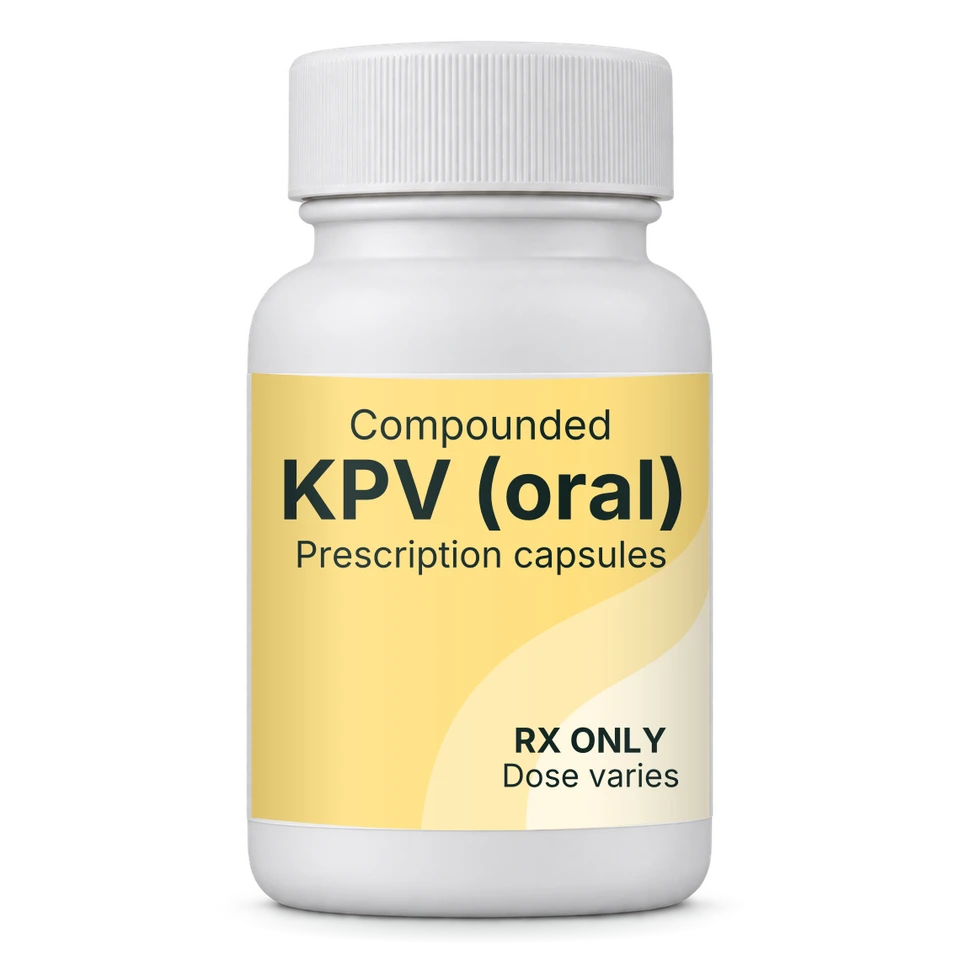


Lys-Pro-ValKPV (oral)
A naturally derived alpha-MSH tripeptide fragment prescribed to support calm inflammatory balance, gut comfort, and healthy skin barrier function.
- Format
- Oral capsule
- Molecule
- KPV tripeptide
- Access
- Prescription only
- FDA status
- Not FDA-approved
$119/mo
Prescription required; a licensed clinician decides if it’s appropriate.
Start the screener 2 min screenerPrivate online screener. A licensed US clinician reviews every request.
What it is
KPV is a short peptide of three amino acids (lysine, proline and valine), a fragment of alpha-MSH, a hormone the pituitary gland makes to help regulate immune responses and inflammation. Early lab and animal research suggests KPV carries much of alpha-MSH’s anti-inflammatory effect. There are no human clinical trials yet.
Designed around:
- A small capsule, swallowed with water
- A licensed clinician review before anything is prescribed
- Check-ins to decide together whether to continue
Not FDA-approved. Results may vary; not everyone responds.
How it’s taken
Swallow the capsule with water, on the schedule your clinician prescribes, and follow the pharmacy label. Don’t change how much or how often you take it without talking to your clinician.
Who prescribes
A US-licensed clinician reviews your screener and health history, may follow up with questions, and decides whether KPV is appropriate for you. If it isn’t, they’ll tell you why. Anything prescribed is prepared by a licensed US pharmacy and shipped to you.
Safety information
KPV is not FDA-approved, and its safety and effectiveness in people have not been established. Most research comes from lab and animal studies. Tell your clinician about every condition and medication, and if you are pregnant, breastfeeding or planning a pregnancy. Full safety information

The potential benefits of KPV.
Explore KPV With a Clinician-
Gut inflammation
Researched for inflammatory bowel conditions. In a mouse study, KPV reduced inflammation in the colon and helped protect the gut barrier.
-
Inflammation in the body
In lab and animal studies, KPV lowered inflammation in the gut, skin and eyes, which is why it is studied for immune-driven conditions.
-
Skin redness and irritation
Explored for inflamed skin, such as redness and breakouts. Lab studies show calmer inflammatory signals in skin cells; there is no human skin data yet.
-
Healing and repair
In mouse and cell studies, KPV supported wound healing, including a 2021 study of a KPV gel for mouth sores caused by chemotherapy.
KPV is not FDA-approved and is not a treatment for any disease. The research so far comes from cell and animal studies; there are no human clinical trials yet. Results may vary; not everyone responds.
Who KPV may be for.
People who explore KPV with a clinician often have one of these in mind. Open one to read more.
KPV is not FDA-approved and is not a treatment for any disease. Most evidence comes from lab and animal studies. A licensed clinician reviews your health history, the potential benefits and risks, and whether KPV is appropriate. It does not replace care you already receive.

When your gut sets the schedule.
KPV is being studied for inflammatory bowel conditions such as colitis. In a mouse study, it reduced colon inflammation and helped protect the gut barrier. There are no human trials yet, so a clinician can explain what is and isn’t known.
When your gut sets the schedule.
KPV is being studied for inflammatory bowel conditions such as colitis. In a mouse study, it reduced colon inflammation and helped protect the gut barrier. There are no human trials yet, so a clinician can explain what is and isn’t known.
For a gut that never quite settles.
People often ask about KPV for bloating and a weakened gut barrier. Animal research suggests KPV helped protect the intestinal lining; whether it does the same in people has not been tested.
Living with inflammation that flares.
A review of lab and animal studies reported less inflammation in the gut, skin and eyes after KPV. That is why people with autoimmune symptoms explore it, alongside the care they already have.
Skin that reacts to everything.
KPV has been explored for inflamed skin, including redness linked to rosacea and acne. The evidence is from lab studies, mostly with topical forms, and there is no human skin data yet.
Support while your body repairs.
In mouse and cell studies, KPV supported wound healing and tissue repair, including a 2021 study of a KPV gel for mouth sores caused by chemotherapy.
An addition, never a replacement.
KPV is discussed alongside the care you already have. Your clinician reviews your full history and medication list first, and you keep seeing the clinicians who treat you today.

How does KPV work?
The leading theory, in three steps. It comes from lab and animal research, and the details in people are still being worked out.
-
01Absorbed in the gut
The capsule dissolves in your digestive tract. In cell studies, KPV is carried into gut cells by PepT1, a transporter built for small peptides.
-
02Quiets a switch
Inside cells, KPV appears to dampen NF-κB, a switch that turns on inflammatory signals. This has been seen in cells and animals, not yet in people.
-
03Reviewed with you
Your clinician sets the schedule and checks in to judge how it’s going. Not everyone responds, and you can stop at any check-in.
This is the proposed mechanism from preclinical research. KPV is not FDA-approved, and how well KPV taken by mouth is absorbed in people has not been established. Results may vary.
A tiny peptide, in two forms.
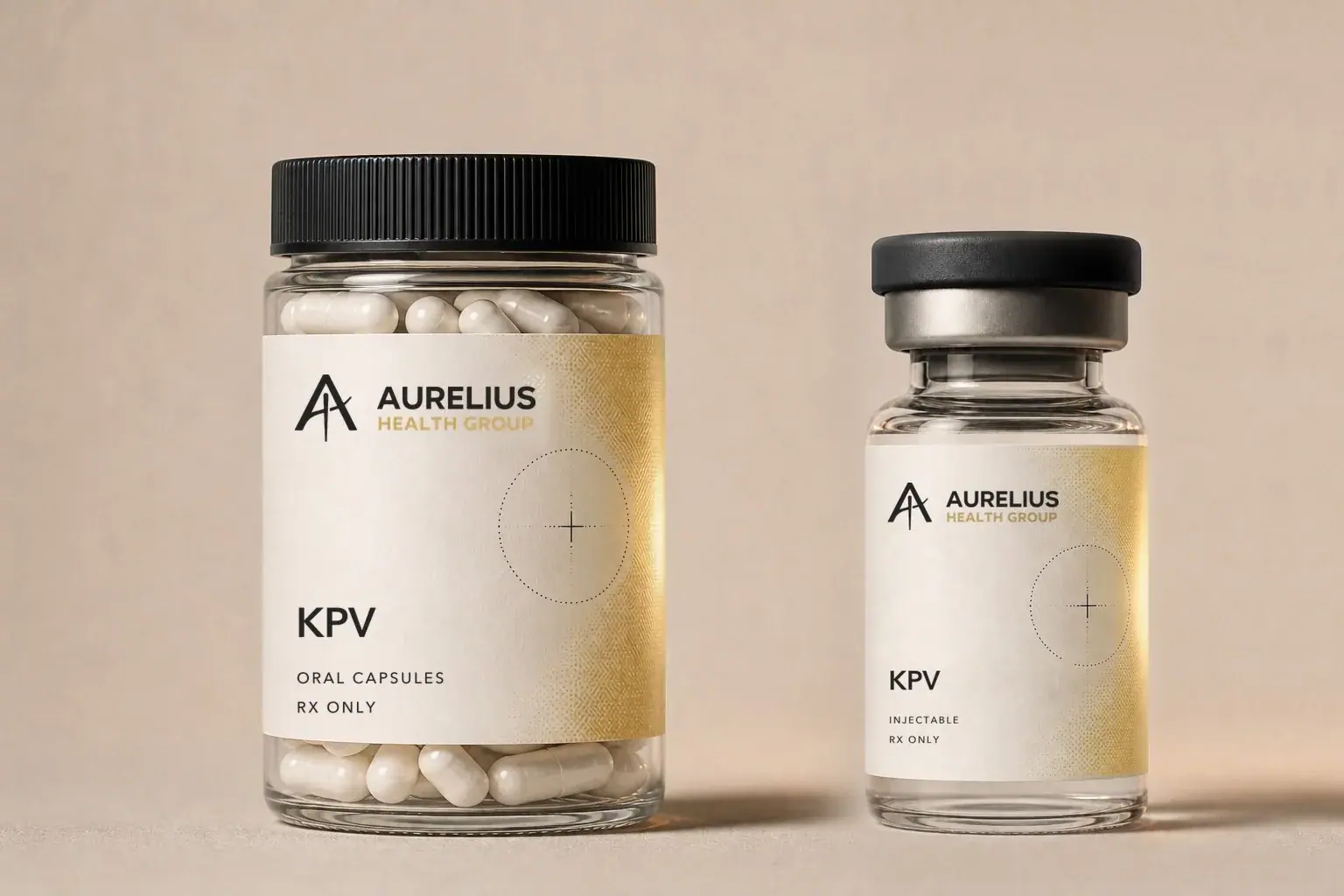
Alpha-MSH, the hormone KPV comes from, is a chain of 13 amino acids. KPV is its last 3, and it comes in 2 forms: a capsule you swallow or a small injection under the skin.
Alpha-MSH is alpha-melanocyte-stimulating hormone. Neither form is FDA-approved. Your clinician decides whether KPV is appropriate and, if so, which form, strength and schedule; the pharmacy label tells you how to take it.

Small steps. Progress over time.
KPV is started with a clinician and reviewed at set check-ins, so you can decide together whether it’s worth continuing.
-
Week 1
Getting started°
- Take your capsule as prescribed, with water
- Note how your gut, energy and sleep feel now
- Message your care team with any questions
-
Week 4
First check-in°
- Review how you’re tolerating it
- Share what you’ve noticed, including no change
- Your clinician decides whether to continue
-
Week 8
Taking stock°
- Compare your notes with where you started
- Decide together whether KPV is worth continuing
- Adjust the plan or stop, with your clinician
-
Ongoing
Personalized support°
- Continue only while it’s right for you
- Check-ins at the interval your clinician sets
- Ongoing access to your care team
°Illustrative care milestones, not guaranteed outcomes. KPV is not FDA-approved, response varies, and some people notice no change. Check-in timing is set by your clinician.
Questions, answered plainly.
Anything else, ask your clinician during your consult.

What is KPV?
KPV is a short peptide made of three amino acids: lysine (K), proline (P) and valine (V). It is a fragment of alpha-MSH, a hormone the pituitary gland makes that helps regulate immune responses and inflammation. Early lab and animal research suggests KPV carries much of alpha-MSH’s anti-inflammatory effect.
Is KPV FDA-approved?
No. KPV is not FDA-approved for any use, and compounded medications are not reviewed by the FDA for safety, effectiveness or quality. FDA is still reviewing whether KPV may be used in compounding, and a clinician prescribes it only where a licensed pharmacy can lawfully prepare it.
How do I take the capsule?
Swallow it with water, on the schedule your clinician prescribes, and follow the pharmacy label. Don’t change how much or how often you take it without asking your clinician first.
How is it injected?
With a small needle just under the skin, usually in the belly or thigh. Your care team shows you how to measure your dose, inject, rotate sites and store the vial. If you would rather not inject, the capsules are the other option.
Oral or injectable: what’s the difference?
Both contain KPV. The capsule is swallowed and avoids needles; an injection skips digestion. How much KPV taken by mouth reaches the body in people hasn’t been well studied, which is one reason your clinician decides which form, if either, suits you.
Who shouldn’t take KPV?
Because human data are limited, your clinician may advise against KPV if you are pregnant, breastfeeding, planning a pregnancy or under 18, or if you have a condition or take a medicine that affects your immune system. Share your full health history and every medication and supplement you take.
What side effects are possible?
There is no formal human safety data for KPV. Nausea, headaches, dizziness and flu-like symptoms have been reported anecdotally, without details on dose or how often. Tell your care team about anything new or unusual, and get medical help right away if you notice signs of an allergic reaction, such as swelling, hives or trouble breathing. With the injection, redness, itching or a small bump where you inject can happen.
Do I stop my other medications?
No. KPV is discussed as an addition to your existing care, never a replacement. Don’t stop or change a prescribed medication without talking to the clinician who prescribed it. Your KPV clinician will want the full list.
Does insurance cover it?
Rarely. KPV is compounded and not FDA-approved, so most people pay out of pocket. It costs $119 a month.
Important safety information
KPV is not FDA-approved. It is a compounded peptide that has not been reviewed by the FDA for safety, effectiveness or quality, and FDA is still reviewing whether it may be used in compounding.
Human data are limited. Most research on KPV comes from lab and animal studies. Its benefits, risks and side effects in people are not well established. Results may vary, and some people notice no change.
Prescription required. A licensed clinician reviews your health history and decides whether KPV is appropriate. Tell them about every condition, medication and supplement, and whether you are pregnant, breastfeeding or planning a pregnancy.
Get help if something feels wrong. Stop taking KPV and seek medical care right away if you have signs of an allergic reaction, such as swelling of the face or throat, hives or trouble breathing. This page is not a substitute for medical advice or emergency care. In an emergency, call 911.

Less discomfort. More life on your terms.
Take the next step in addressing inflammation-related discomfort. Discuss your symptoms and KPV with a clinician.
Before you start treatment
Share your health history
Start with a health assessment. Include your medical history, current medications, and what you’re looking for help with.
Get a clinician’s assessment
A licensed clinician reviews your information and determines whether treatment is appropriate. A prescription depends on that assessment.
Review your plan
If treatment is recommended, ask how to use it, what side effects to watch for, and when to follow up.
Check availability in your state. Review the total cost and any renewal or cancellation terms before you pay.