
New patient intro: $89 first month, then $199/month. Cancel anytime.

AURELIUS HEALTH GROUP MICRODOSE GLP-1 (for lifters) THE 10 REASONS
Now Accepting New Patients

10 Reasons Why Our Patients Don't Lose Muscle Mass On GLP-1.

The 25-40% lean mass loss data was real. It was also published on the maximum FDA permitted dose. Here's the dose response curve, the protein math, and the training architecture that actually preserves muscle.

Written for men who lift 3+ times per week and ruled out GLP-1 because of the muscle loss data. Cites published GLP-1 clinical trial literature. Educational only. Not medical advice.

Board certified MD/DO physicians
48-hour physician review turnaround
HIPAA compliant telehealth
Licensed US compounding pharmacies
Side by Side Comparison

Microdose GLP-1 Performance Stack vs. every other approach for lifters.

A clinical comparison of four approaches to body recomposition and their design for preserving lean mass during a deficit.

Microdose GLP-1 + Protocol Full Dose GLP-1 Only Diet + Training Only No Intervention
Dose calibrated to training context
Protein intake guidance included Varies
Training architecture integrated
Appetite and food noise control
GI side effect burden Low (microdose) High (44% nausea) None None
Lean mass loss rate Lower (slower deficit) 25–39% of total loss Varies by protocol Age related ongoing loss
Performance Stack (NAD+, Carnitine, B12) Varies
Planned step down from day one

Comparison reflects published clinical literature and general prescribing practice patterns. Lean mass loss percentages from STEP-1 and SURMOUNT-1 body composition sub analyses. GI nausea rate from STEP-1 (Wilding et al., NEJM 2021). Individual results vary. GLP-1 medications are not FDA approved for the specific indication of muscle preservation.

Medical documents, prescription bottle and vial on a windowsill representing transparent protocol and pricing
Reason 01

The alarming 25-40% lean muscle loss data came from patients taking the maximum permitted dose.

STEP-1 ran semaglutide 2.4mg weekly. SURMOUNT-1 ran tirzepatide 15mg weekly. Both maximum dose. DEXA sub analyses showed approximately 39% of weight lost as lean mass in the highest loss patients. The data is real. These are properties of the maximum dose protocol, not the medication itself.
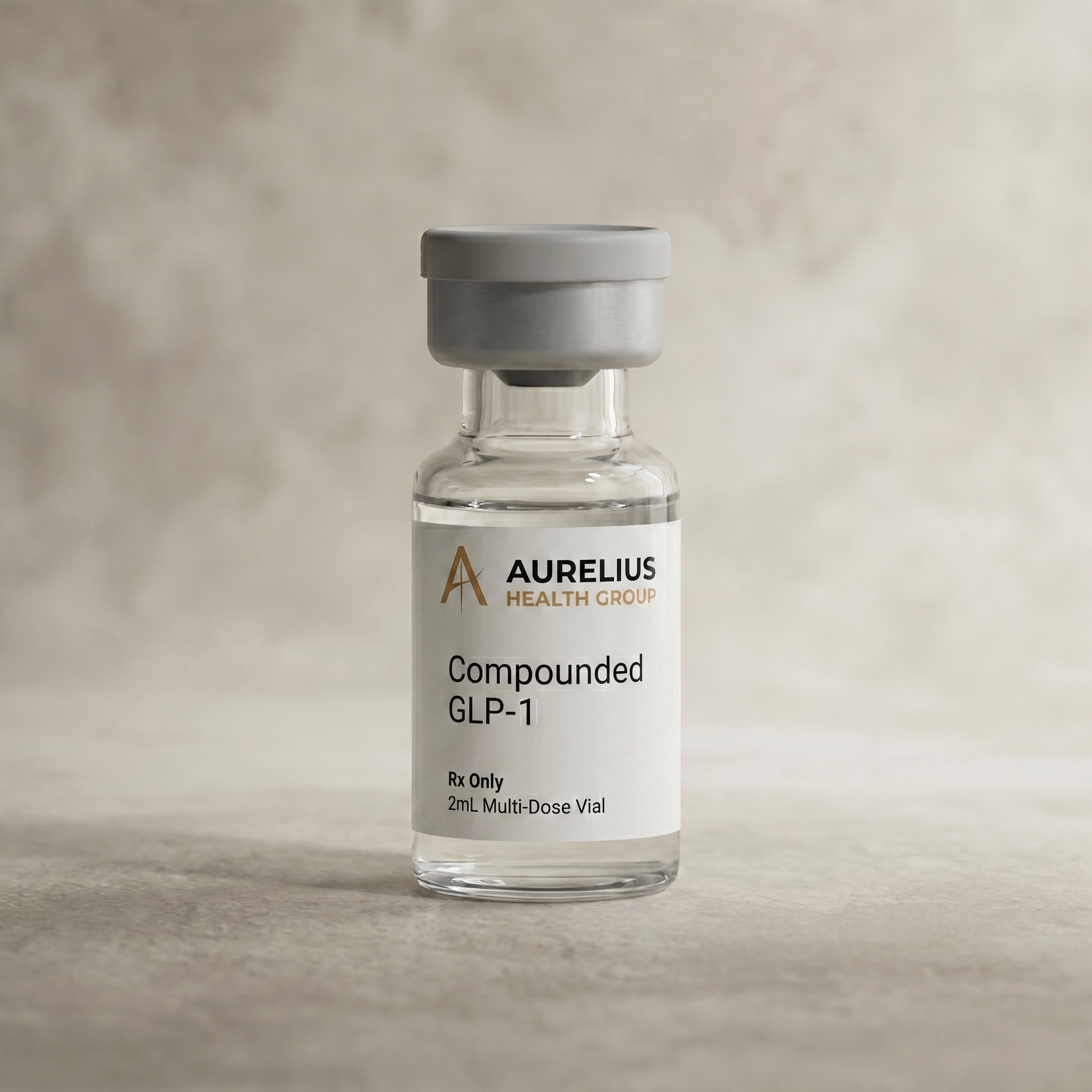
Aurelius compounded GLP-1 protocol vial
Reason 02

Maximum doses are engineered for maximum weight loss, but lower doses offer better control.

STEP-1 ran semaglutide at 2.4mg weekly. SURMOUNT-1 ran tirzepatide at 15mg weekly. Both produced significant weight loss, and both produced the body composition signal that has dominated GLP-1 headlines.

Lower dose protocols are increasingly used in clinical practice, particularly for patients who don't need the maximum weight loss outcome and prefer to preserve lean mass. The published dose response data shows that weight loss scales with dose, but not linearly, and the highest loss patient subgroups, where the lean mass signal is strongest, are concentrated at the top of the dose curve.

A licensed provider can discuss whether a lower dose protocol is appropriate for your situation.
Check Eligibility → 5-minute intake · Physician review in 48 hours · No charge if not a fit
Lifter resting between sets, where side effects and lean mass both track dose
Reason 03

Side effects scale directly with the dose, and muscle loss closely tracks those side effects.

Three mechanisms, all dose dependent:

  • Aggressive deficit: 800 to 1,200 cal/day drives proteolysis
  • Protein underconsumption: intake drops from 0.8 to 1.0g/lb down to 0.5 to 0.7g/lb
  • Reduced training output: side effects suppress training intensity

At microdose, all three mechanisms shift. Same medication. Different protocol. Different outcome.

Meal prep with protein rich foods for the 1g per pound math
Reason 04

1g per pound of target body weight per day is the protein math.

Non negotiable for lean mass preservation. Target body weight, not current weight, as protein synthesis scales with lean mass. A 180 lb target means 180g daily, spread across 4 to 5 feedings of 35 to 45g each. The trap: most lifters who think they are hitting 1g per pound are actually at 0.7 to 0.85g per pound when they log their intake for 28 consecutive days.
Check Eligibility → 5-minute intake · Physician review in 48 hours · No charge if not a fit
Protein shaker on a surface representing liquid protein as a precision tool on microdose
Reason 05

Liquid protein becomes a precision tool, not a crutch, on microdose.

Slowed gastric emptying makes solid food feel heavier than it is. Whey isolate and casein fill the gap without the volume. Leucine density matters more in a deficit, and higher leucine sources trigger stronger protein synthesis per gram than lower quality alternatives.

Lifter mid deadlift showing training architecture on a deficit is manageable
Reason 06

Training architecture changes on a deficit. Not as much as you think.

Three programming adjustments apply:

  • Volume sensitivity increases. Drop redundant accessory work. Keep compounds heavy.
  • RPE awareness. RPE 9 to 10 for one to two key lifts; RPE 7 to 8 for the remainder.
  • Frequency over duration. Four to five sessions of 45 to 60 minutes outperforms two to three marathon sessions.

Numbers should hold or rise on heavy compounds during a successful cut. If they are dropping consistently, deficit management, protein intake, or recovery is broken.

Check Eligibility → 5-minute intake · Physician review in 48 hours · No charge if not a fit
Athletic build representing recomposition as the correct KPI
Reason 07

Recomposition is the goal. The scale is the wrong KPI.

Recomp is fat loss plus lean mass preservation, with strength markers holding or rising. Track these instead: body composition via DEXA every 6 months or InBody weekly, strength markers on bench, squat, and deadlift, visceral fat and waist circumference, and bloodwork including fasting insulin, A1C, lipid panel, testosterone, and SHBG.

Body weight can hold constant for six weeks while body fat drops 3 to 4 percentage points. That is a successful cut by any meaningful measure.

Notebook with protocol notes for planned step down architecture from day one
Reason 08

This protocol has a planned exit from day one.

Standard GLP-1 programs often become indefinite prescriptions. Patients who stop abruptly regain 60 to 75 percent of lost weight within a year. The Aurelius microdose protocol plans the full trajectory upfront: titration, maintenance, and a structured taper. For lifters who already cycle their training, the exit plan is what makes this clinically defensible.

Check Eligibility → 5-minute intake · Physician review in 48 hours · No charge if not a fit
Supplement capsules representing the Aurelius Performance Stack components
Reason 09

The Aurelius Performance Stack is built around the trained body.

The Performance protocol combines:

  • Microdose tirzepatide: dual GIP and GLP-1 receptor agonism, physician titrated to your intake and training context
  • NAD+: mitochondrial function support for cellular energy during training
  • L-Carnitine: fatty acid transport and fat oxidation support
  • Methylcobalamin (B12): active form, energy methylation
Athletic man from behind showing shoulder and arm muscle definition
Reason 10

$89 your first month, $199 after. No contracts, no hidden fees, and cancel anytime.

Your subscription includes physician consultation, prescription review, the full Performance Stack from a US licensed pharmacy, monthly check ins, and optional lab retesting at 12 and 26 weeks. If you are not a candidate after intake, you will not be charged.


Check Eligibility → 5-minute intake · Physician review in 48 hours · No charge if not a fit
Published Research Findings

What the clinical literature shows on lean mass and GLP-1.

These figures are drawn from published GLP-1 clinical trials and body composition sub analyses. They reflect research populations, not Aurelius specific outcomes. Individual results vary.

Proportion of total weight lost that comes from lean mass at full dose semaglutide (STEP-1 DEXA sub analysis, highest loss patients) 39%
Reduction in lean mass loss when structured resistance training is combined with GLP-1 therapy vs. medication alone (Obesity Reviews meta analysis, 2022) ~58%
Weight regained within 12 months of GLP-1 discontinuation, highlighting the importance of resting metabolic rate preservation during the protocol (STEP-1 withdrawal study) 66%

Sources: STEP-1 body composition sub analysis (Rubino et al., NEJM Evidence 2022); Obesity Reviews meta analysis on resistance training and GLP-1 (2022); STEP-1 withdrawal study (Wilding et al., Diabetes Care 2022). GLP-1 medications are not FDA approved for the specific indication of lean mass preservation. These figures represent research populations and individual outcomes will vary.

Pricing

$89 first month. $199/month after. Cancel anytime.

No consultation fee on top. No shipping extras. No long term contract. Month to month, cancel anytime through your patient portal.

Monthly Subscription
$89 first month

then $199/month · cancel anytime

Renews monthly until you cancel.

  • Initial physician consultation (board certified MD/DO)
  • 48-hour prescription review
  • Performance Stack: microdose tirzepatide + NAD+ + L-Carnitine + B12
  • Shipped from US licensed compounding pharmacy
  • Monthly physician check ins + secure messaging
  • Optional lab retesting at 12 and 26 weeks
Check Eligibility

Patient Experiences

What patients say
about the protocol.

Real patients. Individual results vary. Shared with permission.

"

My biggest concern wasn't the weight; staying strong mattered just as much. I lift four days a week and I wasn't willing to give that up. My doctor and I worked out a plan together, and I've kept up my training the whole way through. It feels like the program was built around my life, not the other way around.

Andrew C.

Andrew C., 37

Fitness

"

I went in skeptical. I'd read enough scary things online about side effects that I almost didn't start. What I actually experienced was a slow, steady process where I could text my doctor anytime something felt off, and we adjusted. I wish I'd known how much support there'd be. That's what made it work for me.

Hansen W.

Hansen W., 33

Founder

"

I'm a software engineer. I sit for ten hours a day, and the weight had been creeping up for over a year. I went in skeptical, I'd read the scary side effect threads and almost didn't start. What I actually got was slow and steady, built around how I already lived instead of asking me to rebuild my life. Anything felt off, I messaged my doctor and we adjusted. I didn't expect the support to be the thing that mattered most, but it was. That's what brought my control and confidence back.

M

Maria A., 29

Software Engineer

The dose your body actually needs. The protocol the data actually supports.

If the dose response curve maps to how you already train, the next step is a 5-minute intake. A board certified MD or DO reviews your training context within 48 hours. If you are not a fit, you will know, and you will not be charged.

Check Eligibility
Common Questions

What lifters ask before starting.

Will I actually lose meaningful fat on a subtherapeutic dose?

Published dose response data shows that weight loss scales with GLP-1 dose, but not linearly. Lower dose protocols are increasingly used in clinical practice for patients who want meaningful fat loss without the aggressive caloric deficit that drives lean mass loss at maximum doses. The appetite modulation that supports fat loss persists at lower doses. What changes is the magnitude of the deficit and, with it, the lean mass signal. A licensed provider can assess whether a lower dose protocol is appropriate based on your specific situation.

What is actually in the Performance Stack?

Microdose tirzepatide (dual GIP and GLP-1 receptor agonism), NAD+, L-Carnitine, and methylcobalamin (active B12). The medication handles appetite modulation and insulin dynamics; the supporting compounds address the cellular energy systems that training depends on. Your specific dose is calibrated by your physician based on your intake, training volume, and metabolic history.

Can I keep training hard on this?

Most patients on microdose protocols report training feels normal to good during the recomposition window at weeks 5 to 8. Standard deficit adjustments apply: drop redundant accessory volume, keep compound movements heavy, target RPE 7 to 8 for most sets with one or two RPE 9 to 10 per session. If numbers are dropping consistently across multiple sessions, deficit management, protein intake, or recovery is off and the protocol is adjusted accordingly.

What is the protein requirement?

1g of protein per pound of target body weight per day, spread across 4 to 5 feedings. Non negotiable for lean mass preservation. Most lifters who believe they are hitting target are actually at 0.7 to 0.85g per pound when they log for 28 consecutive days. The intake process reviews your current protein math and the physician sets a specific target before the protocol begins.

Who is this not for?

Microdose GLP-1 protocols are not appropriate for patients with personal or family history of medullary thyroid carcinoma or MEN2, or a history of pancreatitis. Patients on certain interacting medications are also not candidates. Lifters whose protein intake is consistently below 0.8g per pound of target body weight are not strong candidates until that baseline is addressed. The intake screens for all exclusion criteria and the physician will notify you within 48 hours if you are not a fit, and you will not be charged.

How does the pricing work?

$89 first month. $199 every month after. Billed monthly, no long term contract. Cancel anytime through your patient portal before your next billing cycle. Lab testing costs are separate and typically covered by most insurance plans when ordered by a licensed physician.

Is this FDA approved?

The GLP-1 medications prescribed are FDA approved prescription medications for FDA cleared indications including chronic weight management and type 2 diabetes. The specific microdose protocol structure represents a clinical approach to prescribing and has not been independently evaluated by the FDA as a distinct treatment category. Muscle preservation is a clinical goal of the protocol design, not a separate FDA cleared indication.

Can I cancel?

Yes. No long term contract. Cancel anytime before your next billing cycle through your patient portal. There is no cancellation fee and no minimum commitment period.